
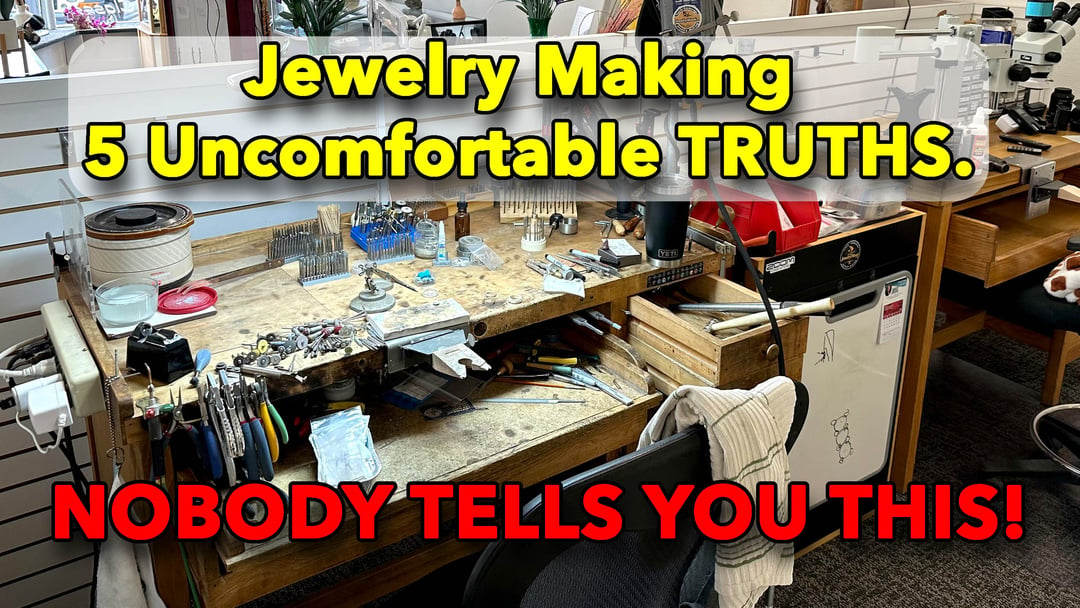
Nobody Told Me This When I Started
I’ve been making jewelry for more than 40 years.
During that time, I’ve made some pieces I’m extremely proud of.
I’ve also melted things I didn’t intend to melt, broken stones, made bad decisions, bought tools I probably didn’t need, and spent a ridiculous amount of time fixing mistakes I created myself.
And after all these years, I’ve come to realize something:
Some of the most valuable lessons in jewelry making aren’t particularly comfortable.
This week I posted a new video called:
5 Uncomfortable Truths About Jewelry Making Nobody Talks About
And while the video is about jewelry, I think these lessons apply to almost anything worth learning.
The Bench Lesson
Here are the five truths:
1. You’re going to destroy things you worked hard to create.
Mistakes are part of the process.
The goal isn’t to reach a point where nothing ever goes wrong.
It’s to become better at recognizing problems, recovering from them, and learning enough that we don’t keep making the same mistakes.
2. Your tools aren’t the reason your jewelry isn’t better.
Now, this one hurts because jewelers love tools.
I certainly do.
But a better torch won’t replace understanding heat.
A better file won’t replace learning how to file.
Good tools help—but they cannot substitute for skill.
3. Most great jewelry making is pretty boring.
Filing.
Sanding.
Measuring.
Checking.
Cleaning.
Doing something again because the first attempt wasn’t quite right.
The spectacular moments are fun, but excellence is usually built in the repetitive work nobody sees.
4. You can’t fix what you can’t see.
One of the biggest skills we develop as craftsmen isn’t just training our hands.
It’s training our eyes.
As we grow, we begin noticing things we couldn’t see before.
A scratch.
An uneven prong.
A poor transition.
A surface that needs another step.
Sometimes noticing more flaws in your work doesn’t mean you’re getting worse.
It means your eye is getting better.
5. You’ll never completely master jewelry making.
After more than four decades, I still see things I could improve.
And I’ve finally learned that this isn’t failure.
It’s part of the craft.
The Life Lesson
I think all five truths point toward one larger lesson:
Growth requires humility.
We have to be willing to say:
I made a mistake.
I need more practice.
I don’t understand this yet.
My technique needs improvement.
Someone else knows something I don’t.
That can be uncomfortable.
But it can also be incredibly freeing.
Because once we stop expecting ourselves to be perfect, we can concentrate on becoming better.
The Problem
Sometimes we confuse excellence with perfection.
Perfection says:
“I shouldn’t make mistakes.”
Excellence says:
“I want to learn from the mistakes I make.”
Perfection says:
“I should already know how to do this.”
Excellence says:
“I can learn.”
Perfection constantly reminds us how far we still have to go.
Excellence allows us to appreciate how far we’ve already come while still taking the next step.
That’s a very different way to approach the bench.
The Solution
Show up.
Do the work.
Pay attention.
Learn from what goes wrong.
Practice the fundamentals.
Train your hands.
Train your eyes.
And try to become just a little better than you were yesterday.
That may not sound very glamorous.
But after a number of years, I still believe that’s how craftsmen are made.
Encouragement
If you’re struggling with something at the bench right now, don’t assume you’re failing.
You may simply be learning.
If you’ve ruined something recently, learn from it.
If your work isn’t where you want it to be yet, keep practicing.
If you’re starting to notice more imperfections, celebrate the fact that your eye is becoming more discerning.
And if you’ve been making jewelry for decades and still feel like there’s more to learn…
Good.
I hope there always is.
Because maybe mastery isn’t reaching some imaginary finish line where there’s nothing left to learn.
Maybe mastery is developing a love for learning that never goes away.
This Week’s Question
Which of these five truths has been the hardest for you to accept?
Or maybe there’s another uncomfortable truth about jewelry making that you would add to the list.
I’d love to hear it.
After more than 40 years at the bench, I’m still learning.
I hope you are too.
Together, Let’s Make the BEST Jewelry of Your LIFE!
Doug
JewelryMonk
Want more like this? Doug shares new techniques, bench videos, and member Q&A on Patreon. Join the Jewelry Monk community on Patreon.
This post originally appeared on Doug’s Patreon.